Build the process, not the pressure
What Is Lean Sales?
Lean Sales applies Lean thinking, the waste-cutting discipline that came out of manufacturing, to the way you sell. You put your time into the customers and activities that create value for the buyer, cut what doesn't, and improve your sales process a little every week.
Where Lean Sales comes from
Lean started on the factory floor. In the decades after World War II, Toyota built its production system around one idea: anything that doesn't add value for the customer is waste, and waste should be removed. In 1996, James Womack and Daniel Jones summed up the approach in their book Lean Thinking, and it spread from car plants to hospitals, software teams and offices.
I've always said that in order to treat the customer well you first have to treat the employees and equipment well. That builds a lot off of lean manufacturing concepts.
Most sales training still focuses on doing more. Adding complication.
Lean asks a different question. Which of those activities actually help the buyer move forward, and which ones just keep you busy?
I learned Lean the practical way, during 35 years at a printing company in Columbus, Ohio, where Lean processes were part of the daily work on real machines and real deadlines. I spent 35 years there, I started in sales in 1990 and led sales & operations as President/CEO for 15 years. Lean Sales Group is the result: Lean thinking, translated for the individual salesperson.
The five Lean principles, applied to sales
Lean Thinking lays out five principles. Here's what each one looks like in a salesperson's week.
1. Value: defined by the buyer
Value is whatever the customer would gladly pay for. In sales, that means insight, a solution to a real problem and an easy buying experience. It doesn't mean your product brochure.
2. Value stream: map how a deal really moves
Write down every step from first contact to signed order. Most reps find steps that exist out of habit: reports nobody reads, meetings with no next step, and follow-ups that repeat the last one.
3. Flow: keep deals moving
Deals die in the gaps: waiting on a quote, a handoff to someone else, a question that sits for a week. Lean sellers shrink those gaps so the buyer's momentum never stalls.
4. Pull: sell when the buyer is ready
Push selling forces a product on whoever will listen. Pull selling means staying visible and useful, so when a buyer's need becomes real, you're the first call.
5. Perfection: improve a little every week
Lean calls this kaizen, or continuous improvement. In Lean Sales it means practicing the same core skills every week and tightening your process with each pass, instead of attending a seminar once and hoping it sticks.
The 8 wastes of selling
Lean teams use the acronym TIMWOODU to spot eight types of waste. Every one of them shows up in a sales week.
Transportation
Deals handed between people and systems, losing context every time they move.
Inventory
A bloated pipeline of stale deals that makes the forecast look healthy and hides the real work.
Motion
Hunting for files, notes and pricing, and switching between five tools to answer one question.
Waiting
Slow follow-up. A prospect who waits three days for a callback is already talking to someone else.
Overproduction
Proposals, decks and samples nobody asked for, made before you know what the buyer needs.
Over-processing
The 12-page proposal when the buyer needed one page and a phone call.
Defects
Wrong quotes, missed details and order errors that cost you the reorder and the customer's trust.
Underutilized human potential
Wins and lessons that stay in one rep's head instead of being shared with the team.
The biggest waste of all is time spent on prospects who were never going to buy. That's why Lean Sales starts with the ideal customer profile.
The Lean Sales method: four parts, one repeating cycle
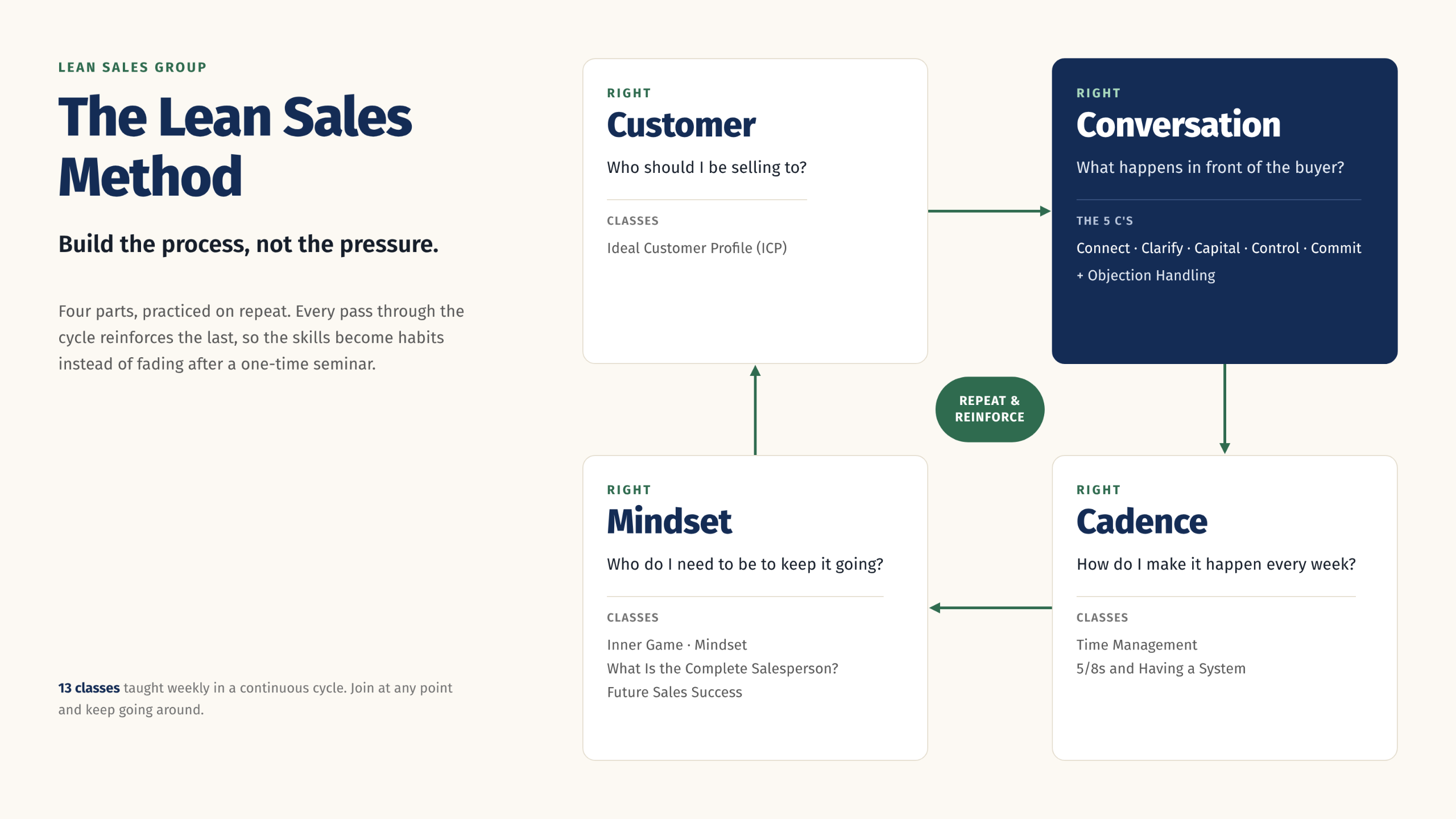
Lean Sales Group teaches Lean Sales in four parts. Each one answers a question every salesperson has to get right.
Right
Customer
Who should I be selling to?
Stop chasing everyone. Define the customers you want most, so every call goes to someone who can actually buy.
Class: Ideal Customer Profile (ICP)
Right
Conversation
What happens in front of the buyer?
The 5 C's give every sales conversation a clear path, from the first connection to a real commitment.
Classes: Connect, Clarify, Capital, Control, Commit, plus Objection Handling
Right
Cadence
How do I make it happen every week?
A weekly rhythm and an outreach system, so selling happens on schedule instead of whenever you remember.
Classes: Time Management, 5/8s and Having a System
Right
Mindset
Who do I need to be to keep it going?
The inner game and habits that keep you consistent when deals stall and the month gets long.
Classes: Inner Game, Mindset, What Is the Complete Salesperson?, Future Sales Success
Repeat and reinforce
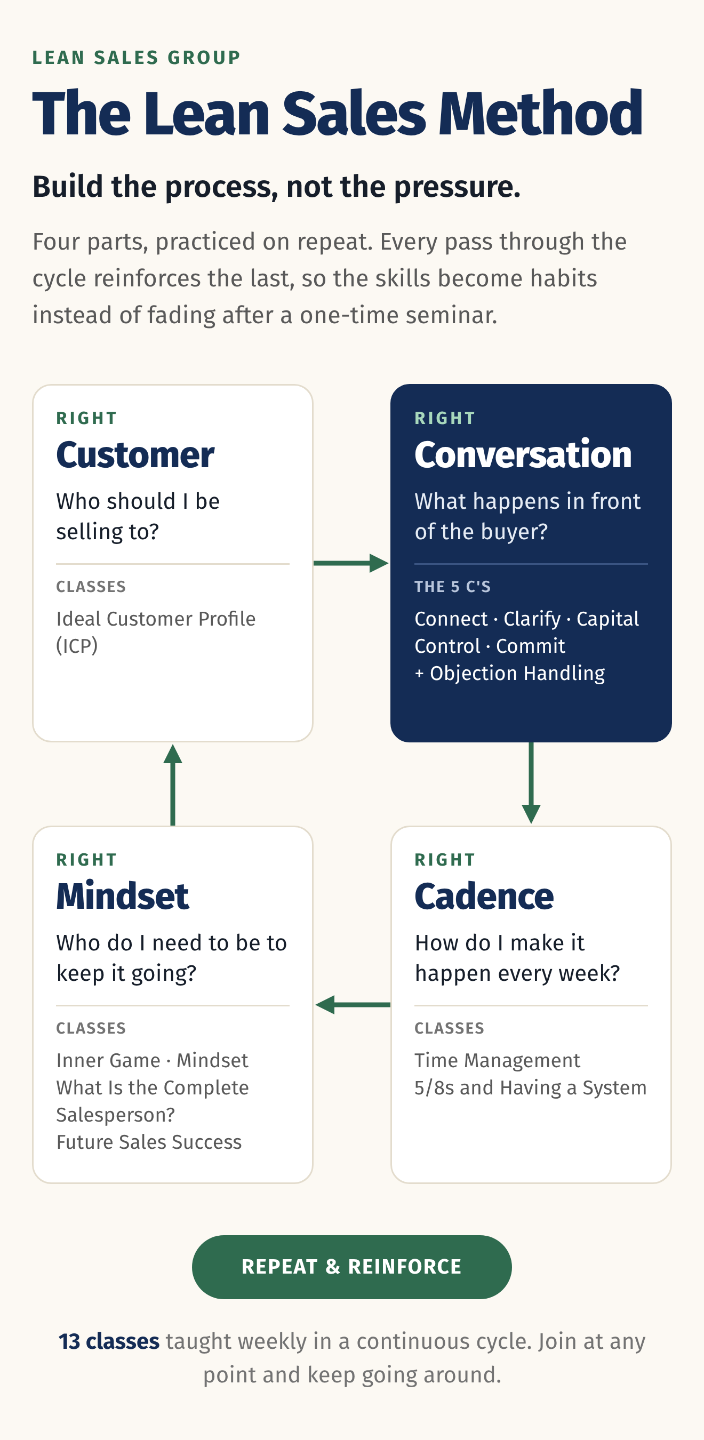
This isn't a seminar you sit through once. The 13 classes are taught live every week in a continuous cycle. Join at any point, keep going around, and every pass builds on the last until the method becomes how you sell. It's Lean's continuous improvement, applied to your own selling.
Lean Sales is not for…
- Anyone looking for a one-day seminar.
- Reps unwilling to change their ways.
- Salespeople who won't put in the weekly reps.
It's for salespeople and sales managers who want a steady, repeatable way to win and grow the right accounts, and who are willing to practice it until it sticks.
Lean Sales questions
What is Lean Sales?
Lean Sales is the application of Lean principles to selling. It focuses a salesperson's time on the right customers and on the activities that create value for the buyer, removes wasted effort, and improves the sales process continuously.
Is Lean Sales only for manufacturing companies?
No. Lean began in manufacturing, but the ideas apply to any B2B sales role, from printing and logistics to distribution and services. If you have a sales process, you have waste you can remove.
How is Lean Sales different from traditional sales training?
Traditional training tends to add tactics and push for more activity. Lean Sales starts by removing what doesn't help the buyer, then builds a repeatable process you practice every week until it becomes habit.
How do I start applying Lean to my sales process?
Start with your customers. Define your ideal customer profile, then look at where your week actually goes and cut the activities that don't move a right-fit buyer forward. Our free ICP booklet walks you through the first step.
Who teaches the Lean Sales method?
Roy Waterhouse, founder of Lean Sales Group, who spent 35 years in B2B sales at Hopkins Printing in Columbus, Ohio. He teaches the method in weekly group coaching and 1 on 1 coaching.
Practice the method every week
Join weekly group coaching, live every Wednesday at noon ET. $89 a month. Cancel anytime.
Not ready to join yet? Here's a free booklet on the ideal customer profile.
How to Identify, Define, and Pursue the customers you want the most
The Ideal Customer Profile (ICP). Written for both new and experienced sales reps.